When testicular pain becomes a constant companion, the goal shifts from managing discomfort to ending it. Chronic orchialgia — pain lasting more than three months — is notoriously difficult to treat, in part because so many providers never identify its true source. For carefully selected men, microsurgical denervation of the spermatic cord can deliver durable relief by targeting the specific nerves carrying the pain, while leaving the testicle and its vital structures fully intact.
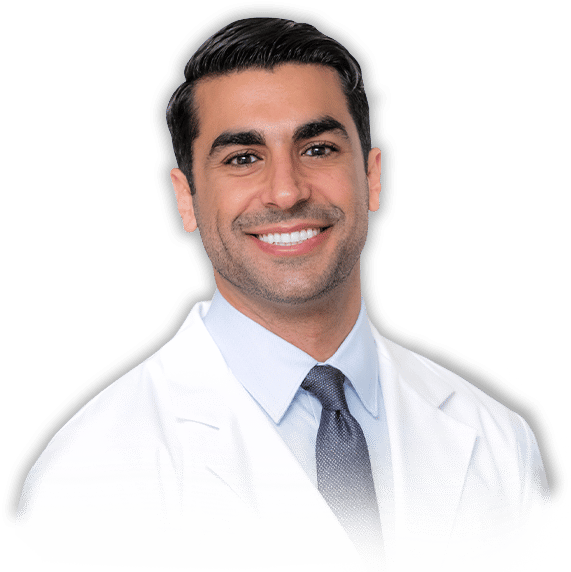
Dr. Justin Houman is a board-certified urologist and Fellow of the American College of Surgeons who has performed more than 1,000 microsurgical spermatic cord denervations, among the highest volumes in the field. Fellowship-trained in male reproductive medicine and microsurgery at UCLA and an Assistant Professor of Urology at Cedars-Sinai Medical Center, he leads a practice designated a Center of Excellence for Testicular Pain and Orchialgia — a referral destination for men with complex, re-operative, and previously unresolved pain.
I had an excellent experience with Dr. Justin Houman, who is truly an expert in male fertility. He took the time to listen carefully and explain all the available options in a way that was easy to understand. His approach is compassionate, professional, and very thorough. I felt confident knowing I was in the care of someone highly specialized in men’s reproductive health. If you are looking for a knowledgeable and caring physician to help with male fertility concerns, I highly recommend Dr. Houman.
What Is Chronic Orchialgia?
Chronic orchialgia is testicular pain — in one or both testicles, constant or intermittent — that persists beyond three months. It can stem from nerve irritation within the spermatic cord, varicoceles, prior inflammation, or pain following a vasectomy or hernia repair. Because the condition is so often misunderstood, many men arrive having already tried multiple treatments without relief. Effective care depends on moving past generic pain management to address the precise mechanism driving the pain.
The Diagnostic Foundation
No surgical decision is made without first confirming where the pain originates. Dr. Houman follows a meticulous, stepwise protocol: a detailed history and physical exam, targeted imaging to rule out structural causes, and — most importantly — a diagnostic nerve block. By numbing the spermatic cord and observing the response, he can determine whether the nerves are the true pain source. Meaningful relief from the block is the single strongest predictor of surgical success, while a negative block is equally informative, redirecting the evaluation toward other sources such as the pelvic floor, spine, or pudendal nerve. This selection process is what separates lasting outcomes from disappointing ones.
Microsurgical Denervation of the Spermatic Cord
For men whose diagnostic block confirms a nerve-driven source, microsurgical denervation offers a targeted, testicle-sparing solution. Using high-powered operating microscope magnification, Dr. Houman identifies and interrupts only the pain-transmitting nerves within the spermatic cord while carefully preserving the testicular artery, the vas deferens, and the lymphatic channels. The outpatient procedure typically takes 45 to 90 minutes, and because so little surrounding tissue is disturbed, recovery is usually straightforward.


Success Rates and Recovery
Outcomes depend heavily on proper selection, which is why the diagnostic block matters so much. In appropriately selected patients who responded to a diagnostic cord block, published literature reports that roughly 70 to 80 percent achieve complete or near-complete pain resolution, with an additional 10 to 15 percent experiencing significant improvement of more than half their pain. Recovery is typically quick: most men return to desk work within three to five days and resume full physical activity within two to three weeks.
Denervation Versus Orchiectomy
A common fear is that treating testicular pain means losing the testicle. It does not. Microsurgical denervation preserves the testicle entirely, interrupting only the nerves responsible for pain while protecting blood supply, hormone production, and fertility. Orchiectomy — removal of the testicle — is considered only as a last resort, in rare cases where denervation has failed and a patient fully accepts the hormonal and cosmetic implications. For the vast majority of men, the testicle-sparing approach is both the first and the most effective choice.
Frequently Asked Questions About Chronic Orchialgia Treatment
-
The best candidates are men whose diagnostic nerve block produced meaningful, temporary relief, since that response is the strongest predictor of surgical success.
-
In carefully selected patients with a positive block, published literature reports roughly 70 to 80 percent achieve complete or near-complete pain relief, with another 10 to 15 percent seeing significant improvement.
-
No — denervation interrupts only the pain-carrying nerves while preserving the testicle, its blood supply, and the vas deferens, with removal considered only as a rare last resort.
-
The procedure is outpatient, with most men returning to desk work within three to five days and full activity within two to three weeks.
-
A negative block is useful information — it suggests the pain isn’t coming from the cord nerves, prompting evaluation of other sources such as the pelvic floor, spine, or pudendal nerve.
-
Yes — for men with post-vasectomy pain syndrome confirmed to be nerve-related, denervation is one option, alongside others such as vasectomy reversal.
Why Patients Choose Dr. Houman for Orchialgia Treatment
- Among the Highest Volumes: More than 1,000 microsurgical denervations performed.
- Selection-Driven Surgery: Diagnostic blocks confirm candidacy before any operation is scheduled.
- Testicle-Sparing Technique: Nerve-sparing microsurgery preserves blood supply, hormones, and fertility.
- Complex-Case Referral Center: A designated Center of Excellence for difficult and re-operative cases.
Meet Dr. Houman
Expert in Men’s Health with Tower Urology and Cedars Sinai
Dr. Justin Houman, MD, FACS is a board-certified urologist and fellowship-trained microsurgeon at Tower Urology, Cedars-Sinai Medical Center in Los Angeles. His subspecialty training in male reproductive medicine and microsurgery is held by fewer than 2% of practicing urologists in the United States.
His clinical focus is narrow by design. Varicoceles, chronic testicular pain, male infertility, vasectomy, testosterone optimization, erectile dysfunction, penile implant surgery, and Peyronie’s disease are not add-on services here. They are the practice. Patients travel from across the country and internationally for procedures, particularly microsurgical varicocelectomy, spermatic cord denervation, and inflatable penile implant surgery, that require a level of subspecialty training and surgical volume most urology practices do not have.
End Chronic Testicular Pain in Los Angeles
Years of unresolved testicular pain can feel permanent, but for many men a precise diagnosis and the right microsurgical approach change everything. Dr. Houman provides careful evaluation and advanced, testicle-sparing treatment for men across Los Angeles and Southern California, including those who’ve been told nothing more could be done. Contact the Los Angeles office to schedule a consultation and find out whether microsurgical denervation could finally bring you relief.