Testicular pain has a way of dominating daily life and being dismissed at the same time. Too many men are told their imaging is normal and they’ll simply have to cope, when in reality the pain usually traces back to a specific, identifiable cause. The key is a careful evaluation that looks beyond a standard ultrasound to find the true source — because that is what makes lasting relief possible.
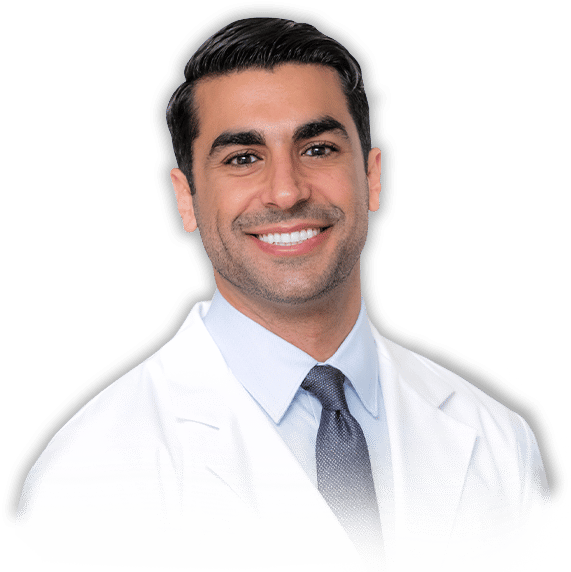
Dr. Justin Houman is a board-certified urologist and Fellow of the American College of Surgeons who has performed more than 1,000 microsurgical spermatic cord denervations, with a practice formally designated a Center of Excellence for Testicular Pain and Orchialgia. Fellowship-trained in male reproductive medicine and microsurgery at UCLA, he serves as an Assistant Professor of Urology at Cedars-Sinai Medical Center and is regularly sought out for the complex, re-operative cases — post-vasectomy pain, post-hernia-repair pain, and nerve entrapment — that other practices have been unable to resolve.
I highly recommend Dr. Houman. He’s a great listener and has provided me with a treatment that has made a positive impact on my life. I trust him 100%. After years of suffering, all of my symptoms have been alleviated and all the health benefits are amazing.
What Is Testicular Pain and Orchialgia?
Orchialgia is the medical term for testicular pain, and when that pain persists longer than three months — whether constant or intermittent, in one testicle or both — it is considered chronic. It affects an estimated 100,000 men in the United States each year and accounts for a meaningful share of all urology visits, yet it remains widely underdiagnosed. The discomfort can range from a dull ache to sharp, activity-related pain, and for many men it carries an emotional toll as well, especially after repeated visits that end without answers.
How Testicular Pain Is Diagnosed
Because so many causes can mimic one another, an accurate diagnosis is the foundation of effective treatment. Dr. Houman follows a deliberate, stepwise process that begins with a thorough history and physical exam, followed by targeted imaging to rule out structural problems. When the source remains unclear, a diagnostic nerve block is often the single most telling step: numbing the spermatic cord and observing the response helps confirm whether the nerves are responsible and strongly predicts who will benefit from denervation surgery. A negative block is equally valuable, redirecting the search toward other sources such as the spine, pelvic floor, or pudendal nerve so that treatment is never aimed at the wrong target.
Spermatic Cord Block: The Test Most Men Have Never Been Offered
A spermatic cord block is a numbing injection placed at the top of the scrotum, where the cord carrying the vessels and nerves to the testicle passes just beneath the skin. It is performed in the office, takes only a few minutes, and requires no sedation — patients are able to drive themselves home afterward.
The block is diagnostic, not therapeutic. Its purpose is to answer one specific question: is the pain traveling through the spermatic cord, or is it coming from somewhere else entirely, such as the pelvic floor, the hip, the lumbar spine, the ilioinguinal or genitofemoral nerves, or a referred visceral source? Isolating the true source is what allows treatment to be targeted correctly instead of guessed at.
It is also the test most men have never been offered. The single largest group of patients Dr. Houman sees are men with a normal ultrasound and no further explanation — the group most often told that nothing more can be done. For many of them, a spermatic cord block is the first step that has ever pointed toward an answer.
A positive block is what identifies who is likely to benefit from microsurgical denervation. Every credible published series on denervation restricts the procedure to patients who responded to a block first, which is why Dr. Houman does not operate without one.
The block is tested against real activity, not just assessed in the exam room. After the injection, the patient stands, walks, and does whatever normally brings on the pain, then logs his pain level before the block, immediately after, and over the following hours. That log, not a single moment in the office, is the actual result.
Substantial relief points to cord-mediated pain and makes a strong case for denervation. Partial relief also supports moving forward with denervation — an incomplete response is often mistaken for a reason to hold off, when more often it means a second contributor is layered on top of the cord-related pain, and both are addressed. No relief is a useful result in its own right: it rules out an operation that would not have worked and redirects the workup toward the true source.
As with any injection, bruising and soreness are common, and hematoma can occur. A positive block predicts a good outcome from denervation; it does not guarantee one.


Treatment Options
Treatment always begins with the least invasive approach that fits the diagnosis. Many men improve with conservative measures such as anti-inflammatory medication, pelvic floor therapy, or nerve-modulating medications. When pain persists and a clear, treatable source is identified, surgical options are tailored to the cause — microsurgical varicocelectomy for varicocele-related pain, or robotic microsurgical spermatic cord denervation for nerve-driven pain confirmed by a diagnostic block. For a closer look at the surgical pathway and outcomes, see chronic orchialgia treatment.
Convenient Locations for Testicular Pain Treatment
Dr. Houman treats testicular pain at convenient Los Angeles-area locations:
Common Causes of Testicular Pain
Effective treatment depends on identifying where the pain truly originates, and several common sources are easy to overlook:
Nerve Irritation or Entrapment
Pain-carrying nerves within the spermatic cord are among the most common and treatable sources.
Varicoceles
Enlarged scrotal veins can produce a dull ache that worsens with standing, activity, or heat.
Post-Vasectomy Pain
A small percentage of men develop persistent discomfort after a
Prior Surgery or Injury
Hernia repair, trauma, or earlier procedures can leave scarring that tethers or compresses nerves.
Infection or Inflammation
Conditions such as epididymitis can trigger pain that lingers after the infection has cleared.
Referred Pain
Pain originating in the back, pelvis, or pelvic floor can present as testicular pain.

Frequently Asked Questions About Testicular Pain and Orchialgia
-
Pain lasting longer than three months, whether constant or intermittent, is generally classified as chronic orchialgia and warrants a thorough evaluation.
-
A normal ultrasound is common and doesn’t mean there is no cause; much testicular pain comes from nerves or subtle changes that standard imaging cannot capture.
-
Beyond history and imaging, a diagnostic nerve block is often the most telling step — relief after the block helps confirm the nerves are responsible and predicts who will respond to denervation.
-
Often, yes — many men improve with conservative measures, and surgery is considered only when those fall short and a clear, treatable source is identified.
-
Depending on the cause, options include microsurgical varicocelectomy for varicocele-related pain and robotic microsurgical spermatic cord denervation for nerve-driven pain.
-
No — chronic testicular pain is a real, physical condition, and dismissing it as psychological is one of the most common mistakes men encounter before finding specialized care.
Why Patients Choose Dr. Houman for Testicular Pain
- Center of Excellence Designation: A practice formally recognized for testicular pain and orchialgia care.
- High Surgical Volume: More than 1,000 microsurgical denervations performed.
- Diagnosis Before Surgery: Nerve blocks and microsurgical testing pinpoint the true source before any operation is considered.
- Complex-Case Expertise: Subspecialty skill in re-operative and previously unresolved pain cases.
Meet Dr. Houman
Expert in Men’s Health with Tower Urology and Cedars Sinai
Dr. Justin Houman, MD, FACS is a board-certified urologist and fellowship-trained microsurgeon at Tower Urology, Cedars-Sinai Medical Center in Los Angeles. His subspecialty training in male reproductive medicine and microsurgery is held by fewer than 2% of practicing urologists in the United States.
His clinical focus is narrow by design. Varicoceles, chronic testicular pain, male infertility, vasectomy, testosterone optimization, erectile dysfunction, penile implant surgery, and Peyronie’s disease are not add-on services here. They are the practice. Patients travel from across the country and internationally for procedures, particularly microsurgical varicocelectomy, spermatic cord denervation, and inflatable penile implant surgery, that require a level of subspecialty training and surgical volume most urology practices do not have.
Treat Testicular Pain in Los Angeles
Living with unexplained testicular pain is exhausting, but being told to live with it is rarely the end of the story. Dr. Houman offers thorough, mechanism-focused evaluation and advanced microsurgical care for men across Los Angeles and Southern California — including those who have already been told nothing more could be done. Contact the Los Angeles office to schedule a consultation and take the first step toward identifying, and finally treating, the true source of your pain.