Many men have some natural curve to their erection, and that’s perfectly normal. But when the bend is pronounced — enough to cause discomfort, self-consciousness, or trouble with intimacy — it’s worth understanding why. Penile curvature has two main causes, and distinguishing between them is the first step toward the right treatment. The encouraging part is that significant curvature, whatever its cause, can usually be corrected.
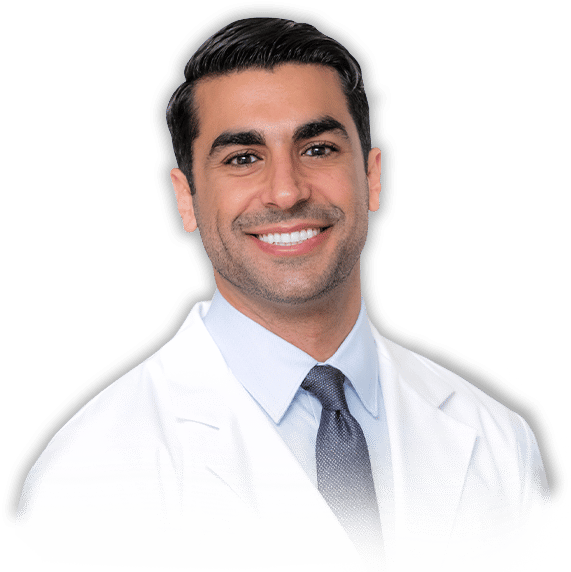
Dr. Justin Houman is a board-certified urologist, Fellow of the American College of Surgeons, and Assistant Professor of Urology at Cedars-Sinai Medical Center, fellowship-trained in male reproductive and sexual medicine at UCLA. He treats the full range of penile curvature — from curvature present since adolescence to curvature caused by Peyronie’s disease — using both non-surgical therapies and reconstructive surgical techniques. Recognized as a Top Doctor in Los Angeles by Los Angeles Magazine, he brings precision and discretion to a deeply personal concern.
I was sent to Dr. Houman from another Urologist that was pretty confused about my situation. Dr. Houman’s team scheduled me quickly, and once we met, Dr. Houman took action immediately. He has a great team that is very nice. He is very personable, listens, jumps right into the trenches, explains everything, and is very responsive. I love working with Dr. Houman, definitely the best Doctor I’ve had!
What Is Penile Curvature?
Penile curvature simply refers to a noticeable bend in the erect penis. A mild curve is common and rarely a problem — many men have one their entire lives without any difficulty. It becomes worth evaluating when the curve is significant enough to cause pain, interfere with intercourse, or affect confidence. Understanding the underlying cause is what determines whether treatment is needed and which approach will work best.
Types of Penile Curvature
Curvature falls into two broad categories, and they call for different treatments:
- Congenital Penile Curvature: Present from birth and usually noticed during adolescence, this type occurs when the chambers of the penis develop unevenly. There’s no scar tissue involved, and the curve is typically stable over time.
- Acquired Penile Curvature: Most often caused by Peyronie’s disease, in which scar tissue (plaque) forms inside the penis after injury or abnormal healing, creating a curve that may develop gradually or suddenly.
What Causes Penile Curvature?
The cause depends on the type. Congenital curvature stems from asymmetric development of the tissue layers of the penis — something a young man is born with, even if it only becomes noticeable as he matures. Acquired curvature usually results from Peyronie’s disease, where minor injury during sex or activity heals into scar tissue that pulls the penis into a bend. Identifying which is at play — through an examination and, when needed, an assessment of the erect penis — guides everything that follows.


When Penile Curvature Needs Treatment
Not every curve requires intervention. Treatment is generally considered when the curvature is pronounced, painful, worsening, or interfering with sexual function or self-confidence. A congenital curve that has never caused difficulty may need nothing at all, while a new or progressing curve — a hallmark of Peyronie’s — warrants a timely evaluation. Dr. Houman helps each man weigh whether treatment makes sense for his particular situation.
Penile Curvature Treatment Options
Because congenital and Peyronie’s-related curvature are different conditions, their treatments differ too:
- Surgical Correction for Congenital Curvature: Procedures such as plication gently straighten the penis by adjusting the longer side; this is the mainstay for significant congenital curves, since there’s no plaque to treat.
- Xiaflex Injections for Peyronie’s: For curvature caused by Peyronie’s plaque, this FDA-approved injectable breaks down scar tissue — offered through the practice’s Xiaflex Center of Excellence. It is not used for congenital curvature, which has no plaque.
- Traction Therapy: Stretching devices can help reduce Peyronie’s-related curvature and preserve length, often alongside other treatments.
- Reconstructive Surgery: For severe or stable curvature, or when ED is also present, plication, grafting, or a penile implant can restore both straightness and function.
Some men ask about shockwave therapy for Peyronie’s; it may help with pain, but its ability to reduce curvature is still considered investigational. For the full range of Peyronie’s-specific care, see the Peyronie’s disease page.
Frequently Asked Questions About Penile Curvature
-
Yes — a slight curve is common and usually no cause for concern; treatment is considered when the curve is significant or causes pain, distress, or difficulty with intimacy.
-
Congenital curvature is present from birth with no scar tissue, while Peyronie’s curvature is acquired and caused by scar-tissue plaque that forms inside the penis.
-
No — Xiaflex treats curvature caused by Peyronie’s plaque; it isn’t used for congenital curvature, which has no plaque and is corrected surgically when needed.
-
Significant congenital curvature is typically corrected with a surgical procedure such as plication, which straightens the penis by adjusting the longer side.
-
Not always — Peyronie’s-related curvature often responds to non-surgical options like Xiaflex and traction, while surgery is reserved for significant congenital curves or severe, stable cases.
-
It can — particularly with Peyronie’s, where scar tissue and curvature may interfere with erections, so treatment often addresses both.
Why Choose Dr. Houman for Penile Curvature Treatment in Los Angeles
- Curvature of Every Type: Expert care for both congenital and Peyronie’s-related curvature.
- Xiaflex Center of Excellence: Advanced non-surgical treatment for Peyronie’s plaque.
- Reconstructive Surgical Skill: Precise straightening procedures when surgery is the answer.
- Discreet, Personalized Care: A sensitive concern handled with expertise and tact.
Meet Dr. Houman
Expert in Men’s Health with Tower Urology and Cedars Sinai
Dr. Justin Houman, MD, FACS is a board-certified urologist and fellowship-trained microsurgeon at Tower Urology, Cedars-Sinai Medical Center in Los Angeles. His subspecialty training in male reproductive medicine and microsurgery is held by fewer than 2% of practicing urologists in the United States.
His clinical focus is narrow by design. Varicoceles, chronic testicular pain, male infertility, vasectomy, testosterone optimization, erectile dysfunction, penile implant surgery, and Peyronie’s disease are not add-on services here. They are the practice. Patients travel from across the country and internationally for procedures, particularly microsurgical varicocelectomy, spermatic cord denervation, and inflatable penile implant surgery, that require a level of subspecialty training and surgical volume most urology practices do not have.
Penile Curvature Treatment in Los Angeles
Whether your curve has been there since adolescence or developed more recently, a significant bend is something you don’t have to simply accept. Dr. Houman offers expert evaluation and the full range of treatments — non-surgical and surgical — for men across Los Angeles and Southern California. Contact the Los Angeles office to schedule a discreet consultation and learn which approach is right for you.