For men living with chronic testicular pain, the hardest part is often being told that nothing is wrong. Normal ultrasounds, inconclusive workups, and a recommendation to simply cope are all too common — yet the pain is real, and in most cases it has an identifiable, treatable source. At his Beverly Hills practice, Dr. Justin Houman takes a different approach: one focused on pinpointing the true mechanism behind the pain and treating it directly.
Dr. Houman is a board-certified urologist and Fellow of the American College of Surgeons whose Beverly Hills clinic has been designated a Center of Excellence for Testicular Pain and Orchialgia. Fellowship-trained in male reproductive medicine and microsurgery at UCLA and an Assistant Professor of Urology at Cedars-Sinai Medical Center, he has performed more than 1,000 microsurgical spermatic cord denervations — a depth of experience that lets him take on the complex and previously unresolved cases that bring men to Beverly Hills from across Southern California and beyond.
I was sent to Dr. Houman from another Urologist that was pretty confused about my situation. Dr. Houman’s team scheduled me quickly, and once we met, Dr. Houman took action immediately. He has a great team that is very nice. He is very personable, listens, jumps right into the trenches, explains everything, and is very responsive. I love working with Dr. Houman, definitely the best Doctor I’ve had!
What Is Chronic Testicular Pain?
Chronic testicular pain, medically known as orchialgia, is persistent discomfort in one or both testicles lasting longer than three months. It affects an estimated 100,000 men in the United States each year, yet it remains one of the most underdiagnosed and undertreated conditions in urology. Part of the reason is that the pain frequently originates from nerves or subtle changes that standard imaging does not reveal — leaving many men cycling through providers without a clear answer.
Why Testicular Pain Is So Often Missed
Effective treatment depends on identifying where the pain actually comes from, and the common sources are easy to overlook on a routine exam:
- Nerve Irritation or Entrapment: Pain-carrying nerves within the spermatic cord are a frequent and treatable source.
- Varicoceles: Enlarged scrotal veins can cause aching discomfort that worsens with activity or heat.
- Post-Vasectomy Pain: A small number of men develop persistent pain after a vasectomy.
- Post-Surgical Pain: Prior hernia repair or other procedures can leave scarring that compresses or tethers nerves.
- Prior Inflammation or Anatomic Changes: Earlier infection or subtle structural issues can leave lasting pain pathways.


How Dr. Houman Diagnoses and Treats Testicular Pain
Rather than moving straight to surgery, Dr. Houman follows a careful, stepwise process designed to find the true cause first. Evaluation begins with a thorough history and physical exam, followed by targeted imaging and, when appropriate, a diagnostic nerve block — a critical step in which numbing the spermatic cord helps confirm whether the nerves are the pain source. Conservative measures are explored first. When pain persists and a diagnostic block points clearly to the nerves, microsurgical spermatic cord denervation can offer lasting relief by interrupting only the pain-carrying nerves while preserving the testicular artery, vas deferens, and lymphatics. When a varicocele is the driver, microsurgical varicocelectomy may be the better solution. For a deeper look at the full treatment pathway, see chronic orchialgia treatment.
Frequently Asked Questions About Chronic Testicular Pain Treatment
-
Common sources include nerve irritation or entrapment within the spermatic cord, varicoceles, prior inflammation, and pain following a vasectomy or hernia repair — many of which are missed on routine imaging.
-
A normal ultrasound doesn’t rule out a real, treatable cause; much chronic testicular pain originates from nerves or subtle changes standard scans don’t show, which is exactly why a mechanism-focused evaluation matters.
-
It is a key step in which a local anesthetic is placed around the spermatic cord, and meaningful relief from the block helps confirm the nerves are the pain source and predicts who will benefit from denervation surgery.
-
Using an operating microscope, Dr. Houman precisely interrupts only the pain-carrying nerves of the spermatic cord while preserving the testicular artery, vas deferens, and lymphatics. Learn more about robotic microsurgical spermatic cord denervation.
-
In carefully selected patients with a positive diagnostic block, published literature reports that roughly 70 to 80 percent achieve complete or near-complete pain relief, with additional patients experiencing significant improvement.
-
Denervation is an outpatient procedure, and most men return to desk work within three to five days and resume full activity within two to three weeks.
Why Patients Choose Dr. Houman in Beverly Hills
- Beverly Hills Center of Excellence: A practice formally designated for testicular pain and orchialgia, right in Beverly Hills.
- Exceptional Surgical Volume: More than 1,000 microsurgical denervations inform every diagnosis and recommendation.
- Mechanism-First Diagnosis: Diagnostic nerve blocks and microsurgical testing identify the true pain source before any surgery is considered.
- Function-Sparing Technique: Nerve-sparing microsurgery targets the pain while protecting testicular health and hormone function.
Meet Dr. Houman
Expert in Men’s Health with Tower Urology and Cedars Sinai
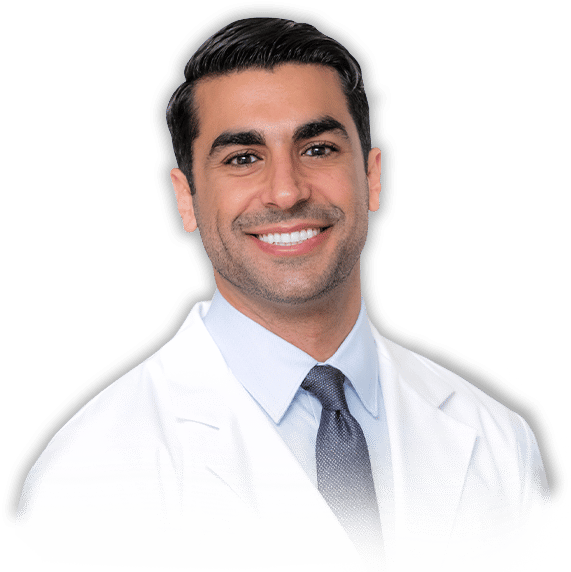
Dr. Justin Houman, MD, FACS is a board-certified urologist and fellowship-trained microsurgeon at Tower Urology, Cedars-Sinai Medical Center in Los Angeles. His subspecialty training in male reproductive medicine and microsurgery is held by fewer than 2% of practicing urologists in the United States.
His clinical focus is narrow by design. Varicoceles, chronic testicular pain, male infertility, vasectomy, testosterone optimization, erectile dysfunction, penile implant surgery, and Peyronie’s disease are not add-on services here. They are the practice. Patients travel from across the country and internationally for procedures, particularly microsurgical varicocelectomy, spermatic cord denervation, and inflatable penile implant surgery, that require a level of subspecialty training and surgical volume most urology practices do not have.
Schedule Testicular Pain Treatment in Beverly Hills
Chronic testicular pain can wear down every part of daily life, but being told to live with it is rarely the end of the story. Dr. Houman offers thorough, mechanism-focused evaluation and advanced microsurgical care at his Beverly Hills practice, including for men who have already been told nothing more could be done. Contact the Beverly Hills office to schedule a consultation and take the first step toward identifying — and finally treating — the true source of your pain.